
What are phytocannabinoids?
In this article you will find out what phytocannabinoids are. We will also tell you about cannabidivarin, as well as the potential health benefits of both cannabinoids.
It is worth mentioning that both phytocannabinoids, such as cannabidivarin, are not as well known as other cannabinoids such as THC and CBD. That is why it is important to know a little more about its properties.
Mostrando 1–8 de 170 resultadosOrdenado por precio: bajo a alto
-

Aceite Higea CBD 10%
24,95€ Añadir al carrito -
Aceite CBD 10%
24,95€ Añadir al carrito -
Aceite CBD 10%
24,95€ Añadir al carrito -
Aceite Higea CBD 10%
24,95€ Añadir al carrito -
Aceite CBD 10%
24,95€ Añadir al carrito -
Aceite Higea CBD 10%
24,95€ Añadir al carrito -
Aceite CBD 10%
24,95€ Añadir al carrito -
Olio di CBD Hygea 20%.
44,95€ Añadir al carrito


Phytocannabinoids Description
Any cannabinoid formed in the trichomes of a cannabis plant is known as a phytocannabinoid. Phytocannabinoids interfere with our body’s receptors as they are extracted from the plant and ingested, producing a variety of psychotropic and therapeutic effects.
It is important to mention that cannabinoids are produced by both plants and animals. In the case of endocannabinoids, they are those formed inside the mammalian body. When it comes to the cannabis plant, there is a recurring question: how many different phytocannabinoids are there? The results obtained are determined by the phytocannabinoids and terpenes present in this strain.
We must understand that cannabinoids are lipophilic molecules that interact with the body’s endocannabinoid system (ECS). Exogenous cannabinoids, also known as phytocannabinoids, are plant-derived cannabinoids formed by glandular trichomes on the surface of cannabis.
On the other hand, trichomes are responsible for the development of all the desirable compounds in the cannabis plant. Scientists have found more than 100 cannabinoids in the cannabis plant, but only the best known, delta-9-tetrahydrocannabinol (THC) and cannabidiol (CBD), have been studied for their potential health benefits.
What is the difference between phytocannabinoids and cannabinoids?
Cannabinoids are a large class of chemical compounds formed by a wide range of biological organisms. In general, these chemicals aid in the regulation and balance of a variety of biological functions in our body.
Furthermore, cannabinoids are divided into two main categories: phytocannabinoids and endocannabinoids. The distinction between the two is evident in that endocannabinoids are produced by humans, while phytocannabinoids are produced by plants.
Now, endogenous cannabinoids, also known as endocannabinoids, are cannabinoids generated by mammals. To function at its full potential, each function of our body needs a particular balance of factors. Homeostasis is the term used when this balance is reached.
Consequently, endocannabinoids contribute to survival by helping the body maintain homeostasis. And because our bodies already use cannabinoid molecules to control a variety of functions, we have a wealth of benefits that the cannabis plant can trigger.
Its interaction with the endocannabinoid system
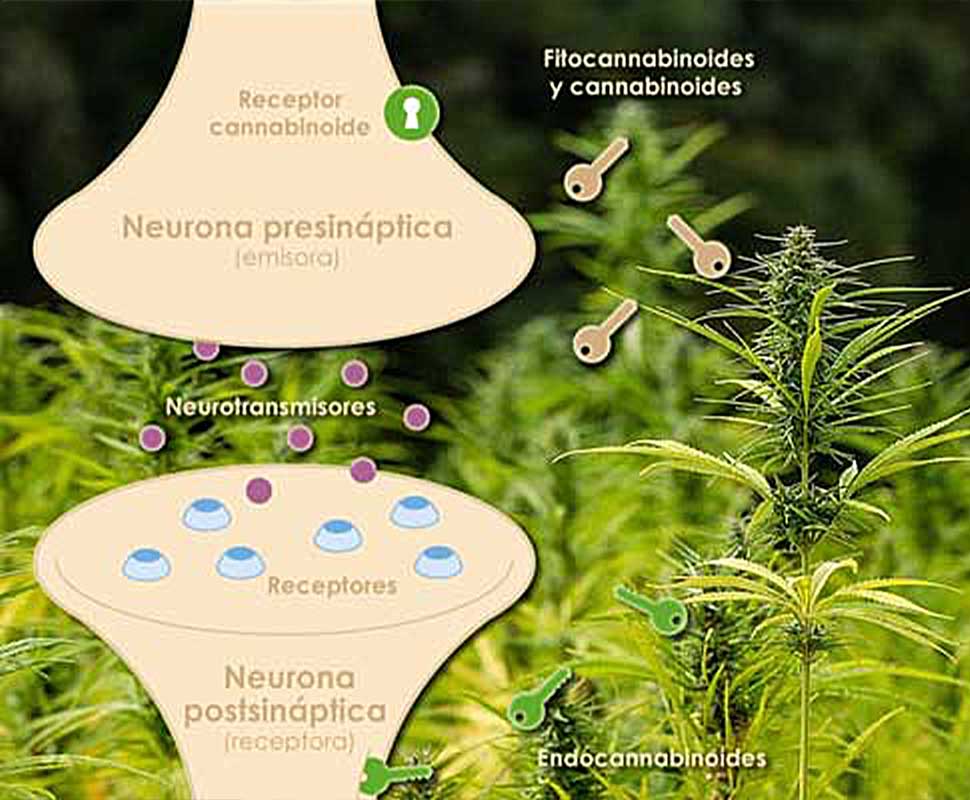
The ECS or endocannabinoid system is made up of three key components that help the body maintain functional balance. These components are the messenger molecules that our body produces, the receptors to which these molecules bind, and enzymes that break them down.
An important thing to keep in mind is that the endogenous cannabinoid system affects a variety of functions, including pain, stress, appetite, energy metabolism, cardiovascular function, motivation, reproduction, and sleep.
CB1 and CB2 receptors are the two most known and studied types of cannabinoid receptors. In the case of CB1 receptors, they are often found in the central nervous system of the brain, where they control a wide range of functions.
In fact, in the brain, they are the most expressed proteins of their type. The main function of the CB1 receptor is to regulate the release of other neurotransmitters, including serotonin, dopamine and glutamate. What it does is control your time and frequency.
An interesting thing to note is that immune cells, which circulate through the body and brain via the bloodstream, contain CB2 receptors. They are also present in neurons in some different parts of the brain. Not only that, immune responses, such as pain and inflammation, are regulated by CB2 receptors.
Because of all of the above, by binding to these receptors, phytocannabinoids interact with the endocannabinoid system, triggering a regulatory response in the body.
What is cannabidivarin (CBDV)?
CBDV, or cannabidivarin, is one of a group of cannabinoids that belong to a group of chemicals formed naturally by the cannabis plant. The cannabinoid CBDV, like its chemical counterparts, interacts with your body’s endocannabinoid system to produce a variety of results.
In addition, CBDV is similar to CBD in several ways, the most important being in terms of its potential therapeutic properties. In other words, just like cannabidiol CBD, this non-intoxicating cannabinoid is present in the cannabis plant.
However, CBDV has not only demonstrated its ability to regulate brain activity by interacting with components of the endocannabinoid system, but has also shown promise in the treatment of epilepsy.

Cannabidivarin: Does it have health benefits?
As mentioned above, the cannabinoid cannabidivarin is effective in the treatment of epilepsy. However, there are also indications that it can be used to treat Crohn’s disease, HIV symptoms, and even multiple sclerosis.
Conclusion on Cannabidivarin
Because of the above, cannabidivarin has been the subject of many important studies, which have revealed the following health benefits:
- Cannabidivarin, like THC, may have therapeutic potential for reducing nausea, according to 2013 research.
- Additionally, during a 2018 study, researchers found that the cannabinoid CBDVmaybe a useful therapy for autism spectrum disorder.
- CBDV improved the health of mice with Rett syndrome, a neurodevelopmental condition that causes behavioral and physiological symptoms, according to this 2018 study.
- Cannabidivarin was found to help improve cognitive, motor and neurological functions, which are associated with certain forms of genetic disorders.
- Finally, in researchon the effects of cannabinoids on muscle quality, it was found that cannabidivarin may help improve muscle quality and slow muscle degeneration in people with Duchenne muscular dystrophy.
Related articles

Abelhas e canábis
Qual é a interação entre abelhas e canábis? A natureza não entende as normas humanas. Entre e descubra!
Las abejas y el cannabis
¿Cuál es la interacción entre las abejas y el cannabis? La naturaleza no entiende de normas humanas. ¡Entra y descúbrelo!

La lecitina negli alimenti a base di cannabis
Sai cos’è la lecitina contenuta nella cannabis e quali benefici ha per te? Scopri di più su questo cibo. Entra subito!
Lecithin in cannabis edibles
Do you know what lecithin contained in cannabis is and what benefits it has for you? Find out more about this food. Come in now!
Lecitina en aliments de cànnabis
Saps què conté la lecitina de cànnabis i quins beneficis té per a tu? Informa’t sobre aquest menjar. Entreu ara!
Lecitina em alimentos de canábis
Você sabe o que é a lecitina contida na cannabis e quais os benefícios que ela tem para você? Saiba mais sobre esta comida. Entra agora!
Subscribe to our newsletter
Subscribe and receive a 10% discount on your purchase.
Store

Guides

Legal notice and privacy policy


Our social networks